Fleet maintenance AI implementation buying starts with clear needs and smart budgeting. Learn how to compare tools and plan rollout.
Buying fleet maintenance AI means choosing software that predicts vehicle problems and automates work orders. For a small business, start by finding software with strong predictions, easy mobile tools, and clear, scalable pricing.
Implementation is a step-by-step rollout. Begin with a pilot on key vehicles, connect your vehicle data, and train your team to act on the AI’s insights. The right purchase turns maintenance from a cost into a strategic tool that cuts downtime and saves money.
Keep reading to learn how to make the process smooth and see real results.
Fleet Maintenance AI Buying Checklist
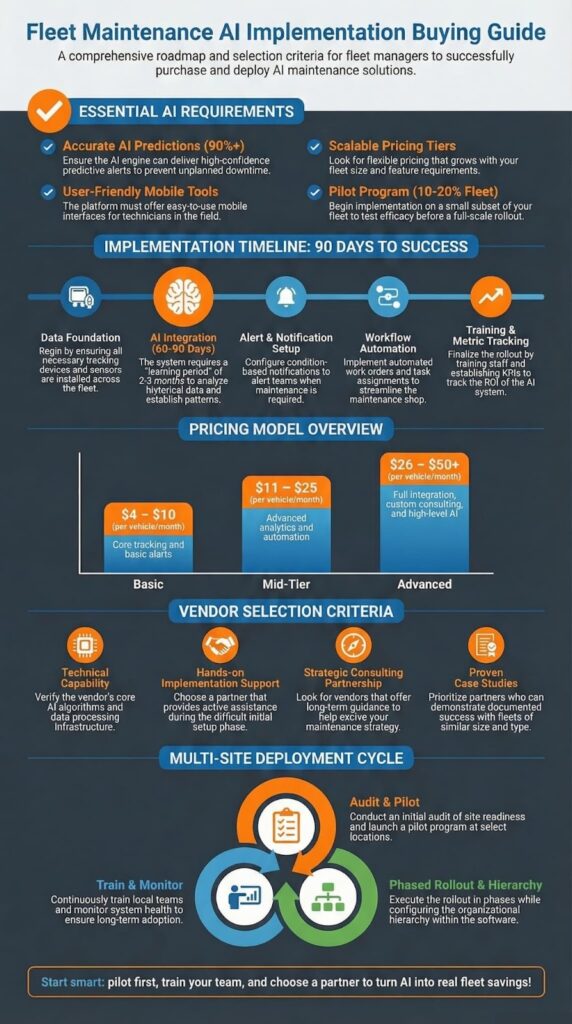
- Look for AI software that is accurate, easy to use, and has clear, scalable pricing. Start with a pilot program.
- Follow a clear process: connect your data, test with a pilot, automate workflows, and train your team thoroughly.
- For multiple locations, standardize upfront, use a phased rollout, and manage everything from a central cloud system.
Identifying the Best AI Fleet Maintenance Software for Small Business

For a small business, the best AI fleet maintenance software works well and is simple to use. Look for a cloud-based system with very accurate predictions. Aim for 90% accuracy or better on important parts like brakes.
As highlighted by ResearchGate / MDPI, AI systems can
“Forecast potential vehicle failures up to 14 days in advance with 85% accuracy,” – ResearchGate / MDPI
It significantly reduces costs through predictive maintenance. The software should run without needing a large IT team.
Key features include a simple mobile app for digital inspections, automated work orders, and basic parts tracking. This lets a small team move from paper-based work to automated, data-driven processes quickly.
The real value is in operational gains. The right software should target your biggest issues: cutting unplanned downtime by 30% or more and reducing annual maintenance costs per vehicle. Industry averages show savings around $2,500 per truck per year.
To reduce risk, pick a vendor that lets you start with a pilot program on 10-20% of your fleet. Focus on high-mileage vehicles. This allows you to test the AI’s accuracy, figure out an early return on investment, and build your team’s trust before committing fully. Many strong platforms are now made for fleets with 5 to 50 vehicles.
How to Implement Predictive Maintenance in Service Fleets
Implementing predictive maintenance in a service fleet requires a step-by-step plan. You need to build a new, data-driven way of working.
Step 1: Data Foundation
Install vehicle tracking devices on your pilot vehicles. This collects real-time data on engine codes, mileage, and sensor readings. This data is the fuel for the AI system.
Step 2: AI Integration and Analysis
Feed this vehicle data into your chosen AI platform. The system will analyze patterns for 60-90 days to learn what is normal for your vehicles and what signals a problem, like brake wear.
Step 3: Alert Configuration
Move away from fixed mileage schedules. Set the system to send alerts based on actual vehicle condition. For example, it will warn you when brake pads have only 500 miles of life left, not just at 30,000 miles.
Step 4: Workflow Automation
Connect the AI’s predictions to your daily work. Set rules so a predicted issue automatically creates a work order, checks for parts, and assigns it to the right technician.
Step 5: Training and Tracking
Train your team to trust and act on the AI’s insights. Track important results, like the average time between failures and how many emergency repairs you have. Fleets using this process have seen major improvements in these areas.
Understanding Pricing Models for Comprehensive Systems
Fleet maintenance AI is usually offered as a monthly subscription, which avoids a large upfront payment. Pricing is tiered based on features and the size of your fleet.
- Basic Tier ($4 – $10/vehicle/month): Covers digital scheduling, maintenance reminders, and basic reports. This is for fleets just starting to move away from paper.
- Mid Tier ($11 – $25/vehicle/month): Often includes the start of predictive features. It adds inventory management, a driver mobile app, cost-per-mile tracking, and basic AI diagnostics.
- Advanced Tier ($26 – $50+/vehicle/month): Unlocks full predictive AI, multi-location management, advanced software connections, and dedicated support.
Most providers have a minimum monthly fee, often around $59, even for a small fleet. Volume discounts usually apply for fleets with 50+ vehicles.
The key financial measure is the payback period. With maintenance cost savings of 25-40%, a well-implemented system often pays for itself in less than nine months. This makes the subscription a high-return operational expense, not just a cost.
Fleet Maintenance AI Pricing Comparison
| Tier Level | Monthly Cost (Per Vehicle) | Core Features | Best For |
| Basic Tier | $4 – $10 | Digital scheduling, reminders, basic reporting | Small fleets moving from paper systems |
| Mid Tier | $11 – $25 | Inventory management, mobile app, cost-per-mile tracking, basic predictive tools | Growing fleets needing better cost control |
| Advanced Tier | $26 – $50+ | Full predictive AI, multi-location management, advanced integrations, dedicated support | Large or multi-site operations |
| Minimum Fee | ~$59/month | Applies regardless of fleet size | Very small fleets |
| Expected Payback | ,, | 25–40% maintenance savings | ROI in under 9 months |
Choosing the Right Fleet Maintenance Service Provider
Selecting a vendor is a partnership. Look beyond the software features to how they support your success.
- Technical Capability: Ask for clear details on AI prediction accuracy, system reliability, and how the platform can grow with your fleet. It should be a true cloud solution.
- Implementation Support: The best providers offer hands-on help during setup. Ask about their process for moving your data, creating custom dashboards, and automating compliance reports.
- Strategic Partnership: Look for a provider that acts as a consultant, not just a seller. As noted by McKinsey & Company,
“Gen AI accelerates data analysis, predicts potential failures, and provides actionable insights” – McKinsey & Company
It is to improve reliability and optimize life cycle costs. They should understand your specific challenges, like managing different vehicle types or automating purchase orders.
- Validation: Request case studies from fleets similar to yours. A credible provider can show real-world results, like how they helped a comparable fleet cut downtime and costs. This proof is more valuable than any feature list.
Steps to Deploy AI Maintenance Across Multiple Locations

Deploying AI across multiple sites, like regional service centers, requires careful planning for consistency and central control.
- Audit and Standardize (2 weeks): Before installing software, review all locations. Centralize maintenance records and standardize policies, like what triggers a “critical” alert. This creates one reliable source of truth.
- Pilot at Select Sites (2-4 weeks): Choose 1-2 locations for the first rollout, often one strong site and one with more challenges. This lets you refine the process and show success in different environments.
- Phased Telematics Rollout (Ongoing): Install vehicle tracking devices in waves. Prioritize assets that move between sites or have the highest repair costs. Ensure all data goes to the central cloud platform.
- Configure Multi-Site Hierarchy (3-4 weeks): In the software, set up your organizational structure. Define user roles (like regional manager or technician) with the right data access and alert permissions for each location.
- Train and Monitor Continuously: Train key staff at pilot sites, then expand the training. Use the AI dashboard to track adoption, work order times, and cost savings across all locations. Compare performance to drive ongoing improvement.
A well-run multi-location deployment can be done in 6-8 weeks. The cloud platform lets you manage hundreds of sites from one dashboard, improving uptime across the entire organization.
FAQ
What should I check before buying AI fleet maintenance software?
Start with a clear AI Strategy and defined fleet management goals. Make sure the system supports predictive maintenance, engine diagnostics OBD2, and J1939 / CAN bus data.
It must connect to vehicle telematics, GPS tracking, and sensor data without complex workarounds. Review its automated maintenance scheduling, predictive parts forecasts, and reporting features before making a decision.
How does AI improve driver safety after implementation?
AI in fleet management improves driver safety through driver monitoring systems, AI dashcam technology, and dashboard cameras. Machine vision AI analyzes driver behavior, assigns safety scores, and flags risky actions in real time.
These insights support Accident Prevention and reinforce your Fleet Safety Policy. Clear reporting also strengthens Driver Engagement and targeted safety coaching.
Can AI systems integrate with existing fleet operations tools?
A reliable AI-driven fleet maintenance system should integrate with TMS platforms, load boards, and Dispatch/Resource Management tools. It must support route optimisation, dynamic routing, and load matching without disrupting daily operations.
Integration with Workforce Management and Spend Management systems improves supply chain performance and delivers measurable Fleet Results across departments.
What data does AI use to deliver predictive analytics?
AI technologies rely on telematics data, sensor streams, and sensor readings from vehicle sensors. They process fuel use, battery levels, GPS location, and engine diagnostics to build accurate Predictive Models.
Machine Learning and neural networks analyze big data and detect fault codes early. Real-time data supports vehicle performance monitoring and efficient maintenance processes.
Is AI adoption suitable for specialized fleet operations?
AI Adoption is suitable for specialized fleets, including those in the waste collection industry that operate garbage truck routes.
Equipment Monitoring tracks automatic tire inflation systems and other critical components. Generative AI and natural language processing can summarize maintenance manuals and customer updates. With strong artificial intelligence systems, implementation becomes structured, scalable, and practical.
From Purchase to Performance
Buying and using fleet maintenance AI is a strategic step. Start by choosing software with accurate predictions, ease of use, and fair pricing. The plan is clear: begin with your data, prove value with a pilot, automate workflows, and train your team. Select a vendor that offers strong technology and real support.
Deploying across multiple sites requires standardizing first and rolling out in phases. The result is a shift from reacting to problems to running a proactive, data-driven operation across your entire organization.See how it works with a free fleet assessment.
References
- https://www.researchgate.net/publication/390194424_AI-DRIVEN_FLEET_ANALYTICS_REVOLUTIONIZING_MODERN_FLEET_MANAGEMENT
- https://www.mckinsey.com/capabilities/operations/our-insights/rewiring-maintenance-with-gen-ai