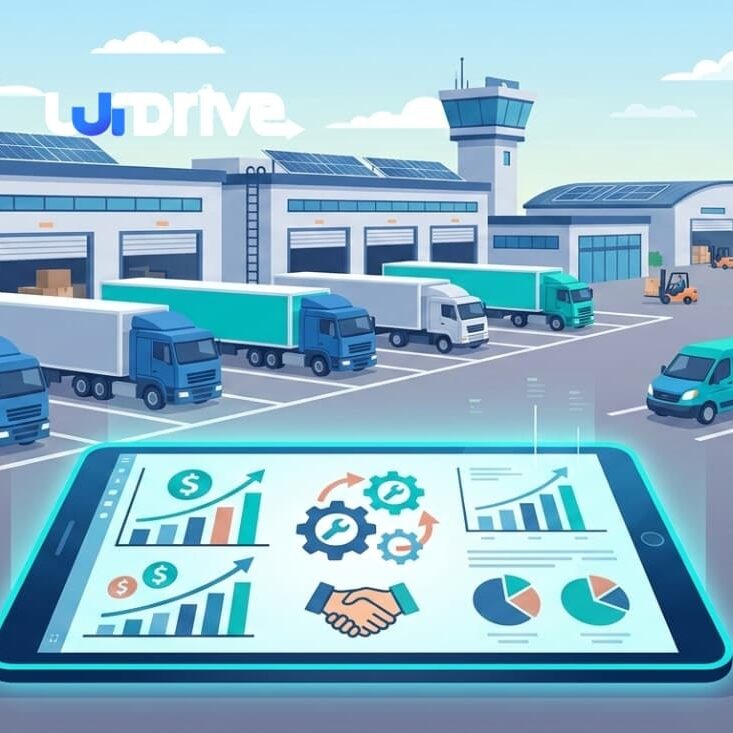
Transform your service fleet with predictive maintenance. This guide shows you how to use data and AI to prevent breakdowns, cut costs, and boost uptime.
Predictive maintenance uses sensors and AI to predict vehicle problems before they happen.
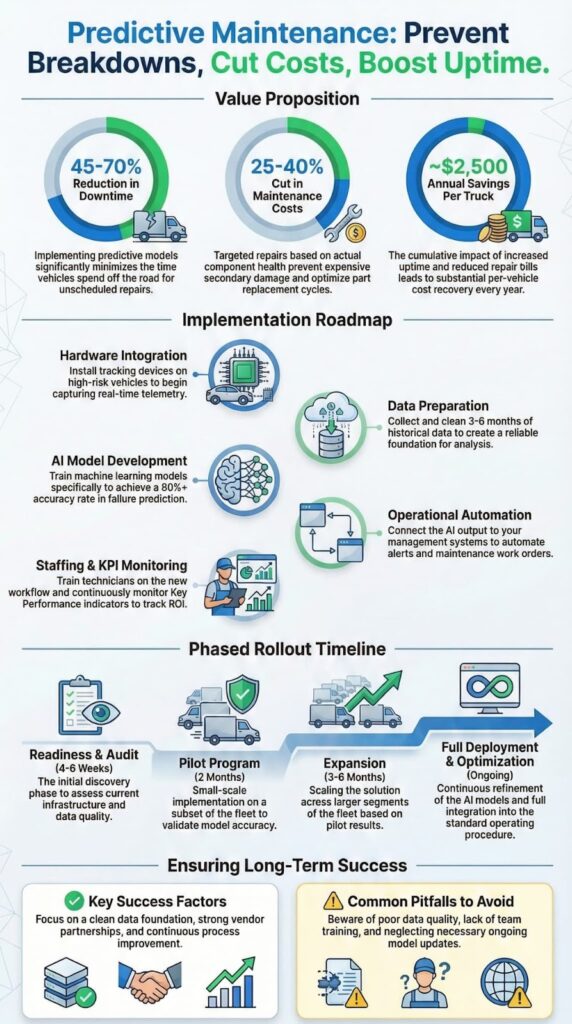
For service fleets, this means planning repairs instead of dealing with expensive emergencies. It can cut unexpected downtime by 45-70% and reduce yearly maintenance costs by 25-40%, saving about $2,500 per truck.
The process involves installing tracking devices, organizing your vehicle history, training the AI with your fleet’s data, and automating repairs from the first alert. The result is fewer breakdowns, longer-lasting vehicles, and more predictable operating costs.
Keep reading to learn how to put this into practice and see the benefits for your fleet.
Predictive Maintenance Implementation Summary
- Start with clean historical data and a pilot program on your highest-risk vehicles to prove the return on investment.
- Effective models need fleet-specific training to achieve over 90% accuracy, moving beyond generic alerts.
- Full value comes from automating the entire workflow, from AI alerts to scheduled, on-site repairs,reducing delays and shop visits.
Understanding Predictive Maintenance for Service Fleets
For a service fleet, a broken-down vehicle means a missed appointment, a frustrated customer, and lost revenue for the day. Predictive maintenance tackles this problem directly.
It’s a strategy that uses real-time data from vehicle sensors and machine learning to predict when a part is likely to fail. This lets you schedule maintenance at the right time, not too early, not too late.
The difference from old methods is clear. Reactive maintenance waits for a breakdown, which is costly and disruptive.
Scheduled preventive maintenance, based only on time or mileage, often leads to unnecessary service. Predictive maintenance uses the actual health of the vehicle, leading to smarter spending and much greater reliability.
The financial results are proven. Fleets using this approach regularly cut unplanned downtime by nearly half and reduce total maintenance costs by 25-40%. For a service business, that means more billable hours and stronger customer trust.
Assessing Your Fleet’s Readiness for Implementation
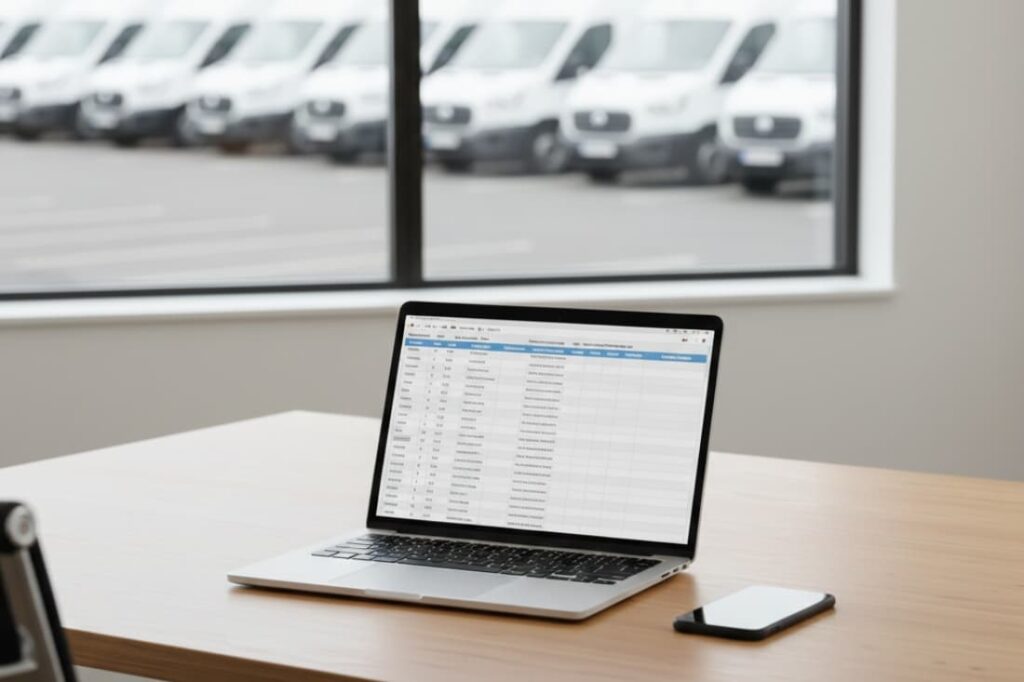
The foundation of any successful predictive maintenance program is your data.
First, assess and organize your information.
- Start by taking an honest look at your current records. Many fleets work with scattered paper logs or incomplete digital files, which creates a “garbage in, garbage out” problem for AI.
- Your first job is to centralize and digitize at least 3-6 months of past maintenance records, repair costs, and vehicle diagnostics. As noted by Deloitte Insights,
“Getting to this level of predictive maintenance begins with incorporating additional data sources… Consolidation and interpretation with AI-enabled signal processing results in a deeper understanding of not just individual machines but the larger network.” – Deloitte Insights
Next, identify and instrument your highest-risk vehicles.
- Find your fleet’s most common failures. For most service fleets, brakes, engines, and electrical systems cause the majority of expensive, unplanned repairs.
- Install basic tracking devices on a pilot group. Start with your high-mileage or most critical units to begin capturing real-time data like engine codes and temperature.
Finally, clean your data and set a baseline.
- This phase is about removing the 20-30% of “noise,” like irrelevant fault codes, to get a clean dataset.
- Set this as your clear starting point to measure future success. Even small fleets can begin by focusing on a pilot group of 10-20% of their vehicles.
Defining Measurable Goals and Pilot Scope
Before buying new software, define success with clear, measurable goals. Avoid vague ideas. Set specific Key Performance Indicators (KPIs) tied to business.
Examples of clear goals:
- A 30% reduction in emergency repair calls.
- A 50% improvement in the average time between vehicle failures.
- Achieving a positive Return on Investment (ROI) within nine months.
These targets will be tested in a controlled pilot program.
How to run a successful pilot:
- Select a sample of 10-20 vehicles that represent your fleet, including high-mileage or high-risk assets.
- The goal is to prove the system’s prediction accuracy, aiming for 85-95% on critical parts like brakes.
- Calculate your real-world savings from avoided breakdowns.
This focused approach lowers risk, builds trust with your team, and provides the solid numbers needed to justify a full rollout.
The Data Collection and Integration Framework
Effective prediction requires good, consistent data. Start by installing sensors and tracking devices on your pilot vehicles. These tools gather vital information around the clock, such as:
- Engine performance
- Location
- Fuel use
- Battery health
- Early fault codes
The next critical step is integration. This data must connect smoothly to a central cloud-based platform, your fleet management system or a dedicated predictive maintenance software. The system needs to link real-time sensor data with past work orders and parts inventory.
Poor integration causes problems. It creates isolated data and too many confusing alerts. For instance, if the system sends 300-400 unclear fault codes every month, technicians will likely start ignoring it.
Proper integration filters out this noise. It delivers only the actionable, prioritized insights that actually help prevent failures.
Building and Training Your Predictive AI Models
This is where data becomes intelligence. Machine learning studies your combined past and current data to spot patterns that warn of a future problem.
For example: The model might learn that a specific increase in engine vibration, along with a rise in operating temperature, predicts a bearing failure with 90% accuracy within the next 500 miles.
The key is customization. A generic, off-the-shelf model can fail 40% of the time. It doesn’t understand your specific vehicles, routes, or driver habits.
Your solution must be tailored:
- Your models must be trained on your fleet’s own data.
- They must distinguish between vehicle types. Wear patterns on a diesel van differ from those on an electric vehicle.
This ongoing process of training and refining the models is what makes the difference. It improves the system’s accuracy, often by 15-20% each year, transforming raw data into trustworthy predictions you can act on.
Automating Alerts and Maintenance Workflows
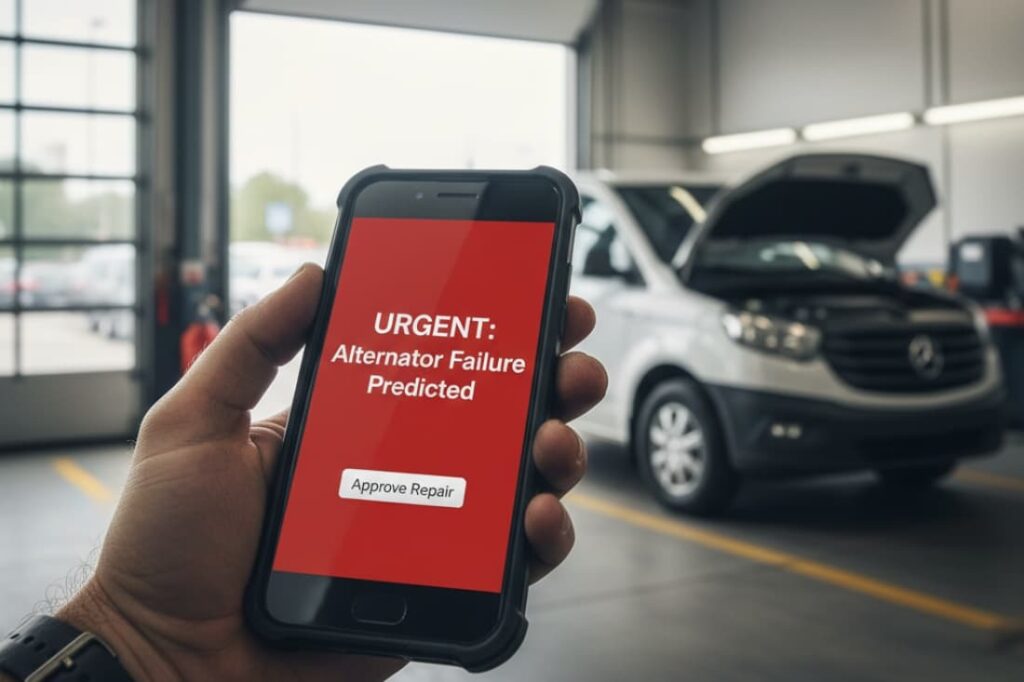
A prediction without action is worthless. The real power of a predictive system is its ability to automate the response.
How automated response works:
- When the AI identifies a high-probability failure, it automatically creates a prioritized work order.
- It checks parts inventory and schedules the repair. As noted by McKinsey & Company,
“A successful system could trigger the maintenance request… check the ERP system for spares on hand, and automatically create a purchase request.” – McKinsey & Company
For service fleets, the goal is zero disruption. The system should schedule maintenance for off-hours, nights or weekends, when vehicles are not in use.
It can send the work order to a mobile maintenance provider or your own shop. This ensures the right technician, with the right parts, arrives at the right time.
This automated workflow can cut the average repair time by up to 40% and reduce emergency repairs by 75%. This keeps your crews on the road and your customers satisfied.
A Phased Rollout Strategy for Fleet-Wide Deployment
A phased rollout manages risk and helps your team adopt the new system. The table below shows a proven implementation timeline, from the first steps to full optimization.
| Phase | Duration | Key Milestone | Expected Impact |
| Readiness & Audit | 4-6 weeks | Clean data baseline established | 20% reduction in data noise |
| Pilot Program | 2 months | 90%+ prediction accuracy validated | 30% fewer emergency roadside calls |
| Expansion | 3-6 months | Auto-scheduling live for 50% of fleet | 45% reduction in unplanned downtime |
| Full Deployment & Optimization | Ongoing | Model retraining and process refinement | 522% improvement in MTBF |
Start with the pilot group to iron out workflows and demonstrate value. Then, expand to 50% of your fleet, incorporating lessons learned. Finally, move to a full deployment.
Throughout this process, technician training is non-negotiable. Your team needs to understand not just what the system is alerting them to, but why.
Training builds trust in the technology. Continuous monitoring of your KPIs is essential to track progress and justify the expansion.
Common Pitfalls and How to Avoid Them

Common Failure Points:
- Poor-quality data: Feeding AI models with incomplete or messy historical records leads to wrong predictions.
- Ignoring the human element: Without proper training and buy-in from technicians and dispatchers, even the best alerts will be ignored.
- “Set it and forget it” mindset: Treating setup as a one-time project leads to failure. Sensors need checking, vehicle profiles change, and models require regular updates to stay accurate.
The Path to Success:
Successful predictive maintenance is a continuous cycle. It requires:
- Discipline to maintain the process.
- A partnership with a provider who understands both the technology and the real-world job of keeping a service fleet on the road.
This cycle involves ongoing data collection, analysis, action, and improvement.
FAQ
What is the first step to implement Predictive Maintenance?
Start by reviewing your current fleet maintenance processes and maintenance records in detail. Define clear goals for Predictive Maintenance, such as reducing Reactive maintenance, lowering costs, and extending vehicle lifespan.
Identify specific Key Performance Indicators for vehicle health and engine performance. Develop practical data strategies before selecting predictive maintenance software or a Predictive fleet maintenance platform.
What data do service fleets need for predictive maintenance?
Service fleets need accurate vehicle data from telematics data systems, vehicle sensors, and diagnostic data tools. Collect engine vibration data, OEM data, battery health information, and driver performance monitoring results.
Real-time data and Real-Time Data Analytics provide continuous insight into Vehicle performance. Proper data integration ensures the predictive vehicle maintenance system delivers reliable condition-based maintenance decisions.
How do AI algorithms improve fleet maintenance results?
AI algorithms and machine learning algorithms analyze large volumes of sensor data through advanced analytics and structured data analysis. They detect patterns in vehicle diagnostics and engine performance that indicate early faults.
Machine learning strengthens predictive analytics and predictive health monitoring. This method improves maintenance scheduling accuracy and reduces unnecessary Preventive maintenance activities.
How should maintenance scheduling change with predictive systems?
Maintenance schedules should move from fixed Preventive maintenance intervals to condition-based maintenance planning.
A predictive maintenance system generates each maintenance work order based on real vehicle health data. It evaluates equipment health, battery management metrics, and performance trends. This approach reduces unnecessary service visits and improves overall fleet management efficiency.
How can fleets measure success after implementation?
Fleets should measure success using clear Key Performance Indicators such as reduced downtime, longer vehicle lifespan, and fewer Reactive maintenance incidents. Use Data Analytics to compare previous maintenance schedules with new predictive analytics outcomes.
Monitor battery health analysis, engine performance metrics, and total vehicle maintenance costs. A robust fleet management platform should provide transparent reports to support informed decisions.
Final Steps to Deploy Predictive Maintenance
Implementing predictive maintenance is the best way to protect your revenue and your reputation. It turns unexpected breakdowns into planned service, giving you control over costs and schedules. The path is clear: start with your data, prove the value with a pilot, and then scale a system built for your operation.
You don’t have to do this alone. The right partner provides the technology, the integration, and the on-site service to make it work smoothly. Stop letting vehicle failures run your day. Take the first step toward a smarter, more reliable fleet.
See how it can work for you with a free fleet assessment.
References
- https://www.deloitte.com/us/en/what-we-do/capabilities/applied-artificial-intelligence/articles/using-ai-in-predictive-maintenance.html
- https://www.mckinsey.com/capabilities/operations/our-insights/ask-an-expert-what-industry-40-can-do-for-maintenance#/