Fleet Maintenance with AI shifts repairs from reactive to predictive. Learn how to cut downtime, improve ROI, and modernize operations.
Fleet maintenance AI uses machine learning to predict vehicle problems before they occur. It automates work orders and makes shop operations more efficient. This directly tackles major industry issues: rising costs, unexpected downtime, and a shortage of technicians.
By analyzing data from vehicle sensors and past records, AI changes your approach from fixed maintenance schedules to flexible, condition-based servicing.
This guide explains the practical steps to buy, implement, and scale an AI solution. The goal is to achieve a clear return on investment and build an operation ready for the future.
Keep reading to learn how to get started and see measurable results.
Predictive Maintenance Essentials
- Start with a clear pilot project, focusing on high-value assets and ensuring the AI works smoothly with your existing software.
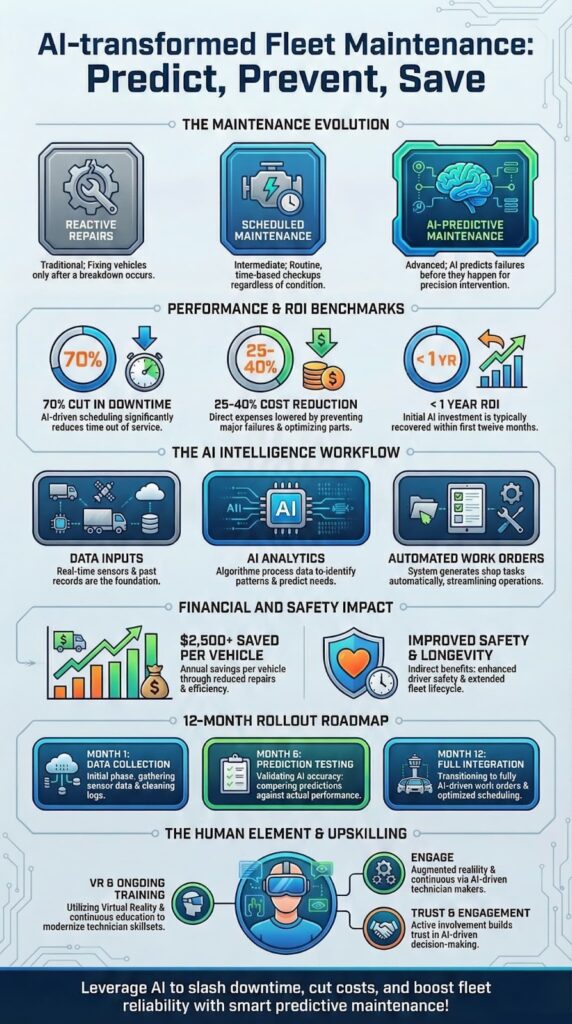
- The return on investment comes from cutting unplanned downtime by up to 70% and reducing annual maintenance costs by 25-40%, often paying for itself in under a year.
- A successful transformation requires investing in your team, training technicians and managers to understand AI insights and trust data-driven processes.
The Foundation of AI Implementation and Buying

Implementing AI in fleet maintenance is about adding a system that works with your current operations. The process starts by understanding your data.
Many platforms are popular because they connect vehicle sensor data, work history, and parts inventory into one intelligent workflow.
Your first check should be compatibility. Can the AI system easily connect with your current fleet and business software without a long, expensive setup?
A smart buying strategy starts with a pilot program. This lowers risk and builds confidence. Choose a small part of your fleet for the pilot, like 10-20% of your vehicles.
Focus on high-mileage trucks or critical equipment where a breakdown is very costly. This lets you test the AI’s predictions on things like brake wear in real conditions. You can compare its forecasts to actual needs and calculate an early return on investment.
When choosing a vendor, consider their support during this phase. Look for partners who help clean your data and adjust the models to your specific operations. This step is key to moving from good predictions to highly reliable, fleet-specific accuracy.
| Implementation Area | Key Question | Why It Matters |
| Data Availability | Do you collect telematics, sensor, and maintenance history data? | AI accuracy depends on data quality |
| System Integration | Can the AI platform connect with existing fleet software? | Avoid costly and complex setup |
| Pilot Scope | Have you selected 10–20% high-value assets for testing? | Reduces risk and validates ROI |
| Vendor Support | Does the provider assist with data cleaning and model tuning? | Ensures fleet-specific accuracy |
| Team Training | Are technicians trained to interpret predictive alerts? | Improves adoption and trust |
| ROI Measurement | Do you track downtime, repair costs, and savings monthly? | Confirms measurable impact |
Calculating ROI and Cost Analysis
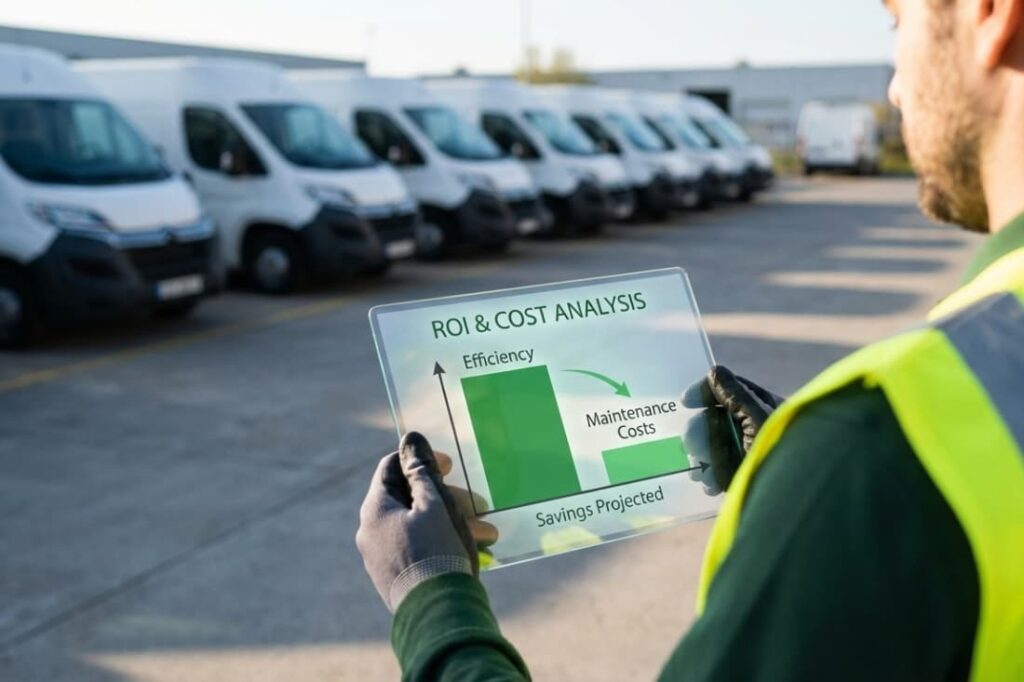
The financial case for fleet maintenance AI is strong and clear. Its main value is turning unexpected, costly breakdowns into planned, efficient maintenance.
As noted by Deloitte Insights,
“AI and machine learning are transforming maintenance from a cost center to a strategic asset… providing prescriptive recommendations that tell operators not only when a part will fail, but what specific action to take.” – Deloitte Insights
The biggest savings come from:
- A major drop in unplanned downtime, often as high as 70%.
- Avoiding expensive single incidents. For one truck, preventing a major roadside breakdown can save thousands in towing, parts, and lost income.
A full cost analysis looks beyond the software fee. The real return on investment includes both direct and indirect savings.
Direct savings include:
- Less overtime for emergency repairs.
- Lower costs for rarely-used emergency parts.
- Better fuel efficiency from optimized driving and maintenance.
Indirect savings are also key:
- Longer vehicle life.
- Improved driver safety and retention.
- Reliable on-time deliveries that strengthen customer trust.
For many fleets, the total savings often reach $2,500 or more per vehicle each year. This typically leads to the AI investment paying for itself in under nine months. This fast payback makes AI a strategic necessity, especially as costs rise.
Crafting a Strategy for AI-Led Transformation
Adopting AI is a strategic change that reshapes your maintenance approach. The journey moves from fixing things when they break, to a set schedule, to predicting issues with real vehicle data, and eventually toward more automated systems. Your plan should map this change.
A typical roadmap starts by gathering vehicle data in the first month. By month six, you should be testing predictions on key systems. The goal for the first year is to have AI creating work orders and helping assign technicians for a pilot group of vehicles.
The most successful changes are led by management but accepted by the shop team. A common issue is distrust of AI recommendations that people don’t understand. Your plan needs clear communication to show that AI is a tool to support human skill, not replace it.
For example, if an AI predicts a brake failure with high confidence using sensor data, it gives the technician exact information. This turns a guess into a targeted repair.
This shift also improves shop workflow. AI can schedule repairs based on parts availability, technician skills, and when the vehicle is free. This moves your shop from constant crisis management to smooth, planned operations.
Navigating Education and Upskilling Trends
The biggest challenge for AI adoption is often people, not technology. The fleet industry already has a shortage of technicians. Now it must also help its current team understand and use data.
The trend is moving toward ongoing, hands-on training. Leading organizations partner with vendors that offer learning programs in vehicle data and AI tools.
These programs teach managers how to read predictive alerts and prioritize work. They train technicians to use AI-driven diagnostics, guiding their inspections more effectively.
New tools like Virtual Reality (VR) simulations are starting to fill the hands-on training gap. A technician can practice diagnosing a complex problem in a virtual environment. This builds skill and confidence without taking a real vehicle out of service.
The goal of this training is to connect data with action. As highlighted in research published via IEEE Xplore,
“AI enables “sensor fusion,” analyzing data from multiple vehicle systems simultaneously, with models achieving up to 95% accuracy in predicting critical component failures and reducing false positives.” – IEEE Xplore
Training ensures that when the system flags an issue, the team understands the urgency, the reason, and the right response. This collaboration between people and AI is where the biggest efficiency gains happen, like consistently completing maintenance on time.
FAQ
Can predictive maintenance really reduce breakdowns?
Predictive maintenance reduces breakdowns by using predictive models based on telematics data, sensor readings, and vehicle performance indicators.
Machine learning algorithms identify patterns linked to component wear and fault detection. Automated maintenance scheduling ensures repairs happen before failures escalate.
This structured approach improves driver safety, lowers unexpected downtime, and keeps maintenance processes consistent and measurable.
What data does AI use in fleet management?
AI technologies process sensor streams from the Internet of Things, including GPS location, battery levels, fuel use, and engine performance data. Dashboard cameras and driver monitoring systems contribute behavioral insights.
Combined with route optimization and load-matching data, these inputs support predictive parts forecasts, supply chain performance tracking, and accurate vehicle performance monitoring across the fleet.
Does AI help with driver safety and behavior?
AI-enabled tools such as AI dashcams and machine vision systems continuously assess driver behavior. Neural networks evaluate speeding, harsh braking, and distracted driving patterns.
Driver monitoring systems generate safety scores that support accident prevention strategies.
This data-driven approach strengthens driver engagement, improves compliance with fleet safety policies, and reduces liability risks for fleet operators.
How should companies plan AI adoption in fleets?
Companies should begin AI adoption with a defined AI strategy aligned to operational goals. Fleet management software must integrate predictive maintenance, equipment monitoring, and route optimisation within dispatch and workforce management systems.
Generative AI and natural language processing can simplify maintenance manuals and reporting. A structured rollout ensures measurable results and sustainable AI-driven fleet maintenance improvements.
Can AI improve fuel efficiency and route planning?
AI improves fuel efficiency by analyzing fuel use, GPS location, and telematics data. Machine learning algorithms support route optimization and dynamic routing to reduce idle time and unnecessary mileage.
Route optimisation tools also consider load matching and traffic patterns. This reduces fuel costs, improves supply chain performance, and supports better overall fleet management decisions.
What role does generative AI play in fleet maintenance?
Generative AI and large language models help teams review maintenance manuals and summarize complex technical data.
Natural language processing allows managers to ask simple questions about vehicle telematics or maintenance history.
AI technologies can also assist with predictive parts forecasts and preventative maintenance bundling. This makes AI adoption more practical and easier to scale across fleet operations.
The Road Ahead for Intelligent Fleets
Integrating AI into fleet maintenance is a major shift from fixing problems to predicting them. This journey requires a clear plan: a careful buying process, understanding the financial return, and investing in your team’s training.
The results are clear. Fleets using AI gain better reliability, controlled costs, and improved safety. They turn maintenance from an expense into a strategic advantage. The question is no longer “if,” but “how soon.”
The tools are ready and the return is proven. See how it can work for your fleet with a free assessment.
References
- https://www.deloitte.com/us/en/what-we-do/capabilities/applied-artificial-intelligence/articles/using-ai-in-predictive-maintenance.html
- https://ieeexplore.ieee.org/document/10939072