
Compare pricing models for comprehensive fleet maintenance systems. Discover how per-vehicle and tiered plans impact your ROI and long-term costs.
The right pricing model for a fleet maintenance system is the one that scales with your growth, provides a clear return on investment, and integrates the tools you need.
The most common options are per-vehicle subscriptions, tiered packages, and performance-based models.
Each one aligns your costs with fleet size, vehicle types, and goals like cutting fuel consumption or preventing breakdowns. Choosing correctly impacts your budget and daily efficiency.
Continue reading to find which strategy delivers the most value for your specific operation.
Fleet Subscription Insights: Choose What Fits Your Business
These key points summarize the main options and costs, helping you pick a fleet subscription model that balances value, flexibility, and total cost.
- Per-Vehicle Subscriptions offer predictable, scalable costs ideal for small to mid-sized fleets.
- Tiered & Performance Models provide flexibility for larger or specialized operations, letting you pay for advanced features.
- The True Total Cost includes hidden factors like setup and data fees, not just the monthly rate.
Per-Vehicle Subscription: The Dominant Fleet Pricing Model
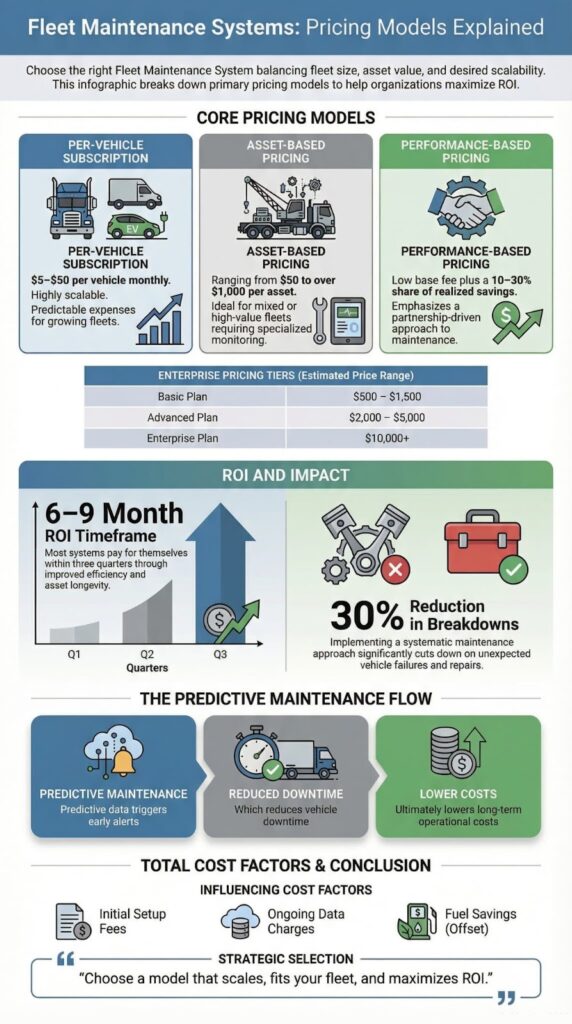
The per-vehicle monthly subscription is the most popular model, used in about 65% of systems. It’s simple: you pay a set fee for each truck or van every month. This turns a large upfront investment into a predictable operational cost, making it easier to budget as your fleet grows.
Costs typically range from $5 to $50 per vehicle, depending on the features. Basic GPS tracking and maintenance reminders sit at the lower end.
More advanced plans include predictive failure alerts and automated scheduling. Many providers include necessary hardware, like OBD-II devices, with your service plan.
The real value comes from reducing costs elsewhere. Industry data shows fleets often see a return on their investment in 6 to 9 months.
This comes from a significant drop in unexpected breakdowns, sometimes by 30%, and more efficient maintenance scheduling that leverages predictive maintenance workflows to optimize uptime.
In a recent analysis by ResearchGate / Transforming Fleet Financing with AI
“AI helps determine accurate upfront pricing models, primarily through analyzing the cost data and generating likely costs for the future. … This model offered the company a straightforward fixed cost, creating better budget control. … The pricing strategy incorporated an analysis of every client’s needs and product usage, which should closely mirror the cost of the system.” – ResearchGate / Transforming Fleet Financing with AI
A look at common pricing tiers:
| Tier | Cost per Vehicle/Month | Core Capabilities | Ideal For |
| Basic | $5 – $15 | Real-time GPS, basic maintenance reminders, fuel tracking | Small fleets needing simple visibility |
| Standard | $20 – $35 | Predictive failure alerts, driver behavior monitoring, work order management | Growing fleets focused on controlling costs |
| Premium | $40 – $100+ | Prescriptive auto-scheduling, automated driver coaching, detailed analytics | Large fleets minimizing total cost of ownership |
One thing to watch for is “add-on shock.” The base price might not include everything. Features like fuel management integrations or extra user accounts can increase your final monthly cost. Always calculate the total based on the tools you actually need.
Asset-Based Pricing for Mixed and High-Value Fleets
Asset-based pricing charges you based on the specific vehicle, not a flat fee. A standard service van might cost between $50 and $200 monthly.
A heavy-duty truck or an electric vehicle with complex battery monitoring could range from $300 to $1,000, especially when enhanced with fleet AI tools that deliver deeper insights into performance and downtime.
This model is powerful for mixed fleets. It lets you focus your budget on the most critical vehicles, the ones that cause the most downtime.
By applying advanced monitoring to these key assets, you can see a significant return. Some fleets report a 45% reduction in downtime costs for those specific vehicles.
As highlighted by International Journal For Innovative Engineering and Management Research
“The introduction of AI in the fleet financing industry has changed the industry by bringing innovation in the approaches of competitively priced, flexible, and transparent models. … [Using] algorithmic analytics and process integration … [systems] create adaptive and customizable lease agreements that could be signed with daily changes in mind. This approach helped ensure high fleet utilization and the reduction of average idle time.” – International Journal For Innovative Engineering and Management Research
Quick Overview:
- Cost Range: $50–$1,000+ per month, depending on vehicle type and complexity.
- Best For: Fleets with a mix of light, medium, and heavy-duty vehicles, or those adding electric vehicles.
- Hardware Note: Upfront costs for telematics devices are often waived with a service commitment.
The goal is to protect your most valuable equipment. You invest more in monitoring them because they have the biggest impact on your bottom line.
Tiered Feature Packages for Scalable Fleet Operations
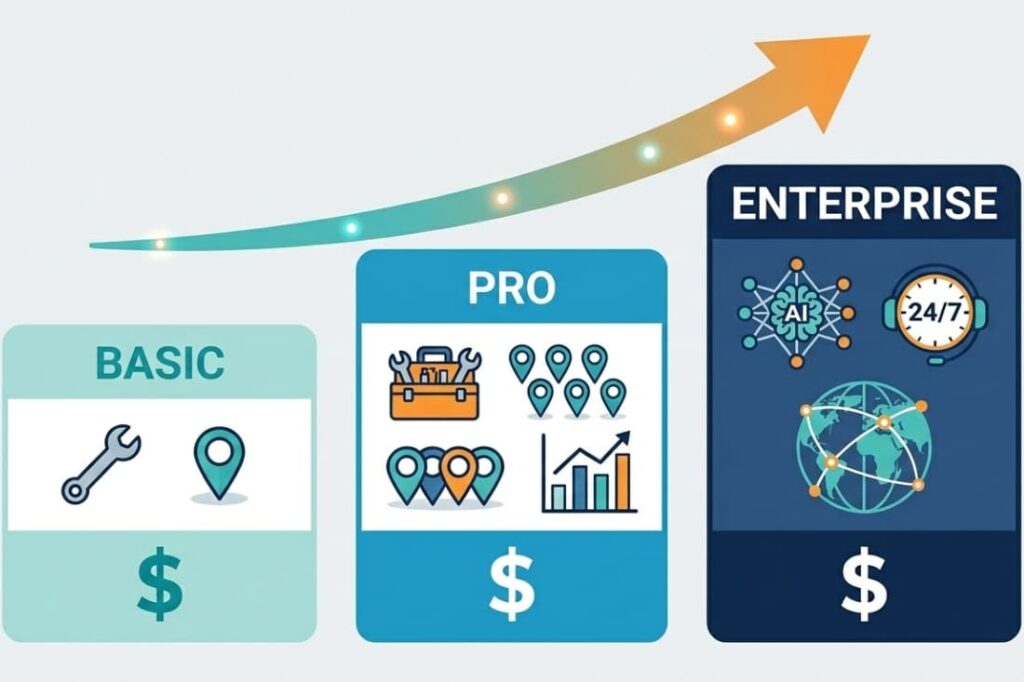
Tiered pricing offers a fixed monthly fee for a set bundle of features, no matter how many vehicles you have. This gives larger fleets predictable costs and is excellent for testing new technology before a full rollout.
You can start with a Basic package to get core alerts and tracking. After proving the value over a few months, you can scale up to an Advanced or Enterprise plan for more powerful tools. This step-up approach is common, used by about 40% of fleets adopting new systems.
A look at common tiered plans:
| Plan | Monthly Cost | Key Features |
| Basic | $500 – $1,500 | Fault code alerts, basic vehicle tracking, maintenance scheduling |
| Advanced | $2,000 – $5,000 | Predictive analytics, dynamic work order generation, fuel consumption analysis |
| Enterprise | $10,000+ | Full automation (parts ordering, technician dispatch), custom API integrations, advanced driver management systems |
The main advantage is predictable budgeting and the ability to scale within your plan. One thing to consider is that if your fleet is small, you might pay for more capability than you currently need. The goal is to choose a tier that matches your current size and future growth.
Performance-Based Pricing and Risk-Sharing Models
For fleet managers who want proof before a full commitment, the performance-based model offers a clear path.
In this approach, you pay a lower base fee, and the service provider earns a share of the verified savings you achieve together, typically between 10% and 30%, reinforcing why modern AI implementation can be structured around measurable outcomes that both sides benefit from.
This model is built on hitting specific, measurable goals. Common targets include reducing unplanned breakdowns, achieving a set dollar amount in maintenance savings per vehicle, or cutting idle fuel costs. It starts with a detailed assessment of your current costs to establish a clear baseline.
How it works:
- Structure: A lower monthly subscription, plus a percentage of proven savings.
- Common Goals: Reducing unplanned breakdowns, achieving maintenance savings (e.g., $2,500 per truck/year), cutting idle fuel use.
- Growth: This model is gaining popularity as more fleets seek accountable partnerships.
This model builds significant trust. The provider’s success is directly tied to improving your uptime and cutting your costs. It’s a partnership where both sides win when your fleet runs more efficiently.
How Pricing Impacts Your Total Cost of Ownership (TCO)
The monthly software fee is just one part of the total cost. The right system should lower your much larger expenses. A good predictive maintenance system can cut unplanned downtime by 30% or more. Since downtime can cost over $600 per vehicle, per day, the savings add up fast.
When you compare pricing models, look beyond the base rate. Consider the full picture of what you’re getting and what it will save you.
Key factors to evaluate:
- Integration Costs: Fees for connecting to your existing fuel cards or business software.
- Data & Service Fees: Potential charges for high data usage or advanced features.
- Efficiency Gains: Real savings come from better fuel use, optimized maintenance schedules, and insights that help you right-size your fleet.
The goal is a system that pays for itself. It gives you control over maintenance costs, fuel spend, and driver safety. This transforms maintenance from a reactive headache into a predictable, optimized part of your operation.
FAQ
What factors influence pricing models for comprehensive fleet maintenance systems?
Pricing models for fleet maintenance systems depend on fleet size, vehicle type, and the complexity of fleet operations.
Systems that include GPS tracking, predictive maintenance, preventive maintenance, and driver behavior monitoring usually cost more. Total cost of ownership also considers vehicle downtime, fuel consumption, and fleet utilization.
Fleet managers should analyze fleet data to select a plan that matches operational needs, maintenance schedules, and overall cost savings.
How do vehicle maintenance and repair scheduling affect overall fleet costs?
Vehicle maintenance and repair scheduling directly impact vehicle uptime and overall fleet costs. Work order management, preventive maintenance scheduling, and real-time vehicle tracking reduce unexpected downtime and expensive repairs.
Effective fleet management software allows managers to monitor vehicle maintenance history, track work orders, and evaluate driver performance. These practices improve fuel efficiency, ensure driver safety, and optimize fleet operations.
What role does driver behavior analysis play in pricing structures?
Driver behavior analysis influences fleet maintenance costs by reducing fuel expenses, improving safety, and lowering wear on vehicles.
Automated driver alerts, driver coaching, and advanced driver assistance systems prevent accidents and unnecessary repairs.
Integrating predictive technology and real-time driver hour tracking helps fleet managers assess performance accurately and make informed budgeting decisions.
How do fuel management programs impact fleet maintenance system pricing?
Fuel management programs, including fuel cards, fuel tracking, and fuel logging, affect total fleet expenses and pricing. Monitoring fuel usage, fuel prices, and fuel station interactions helps improve efficiency and reduce waste.
Fleet telematics systems that integrate fuel management with maintenance strategy provide actionable insights, allowing managers to optimize vehicle utilization, improve fleet operations, and control overall costs.
Why is predictive maintenance important for cost-effective fleet management?
Predictive maintenance uses machine learning and connected vehicle technology to anticipate problems before they occur. This reduces unexpected downtime and enables efficient maintenance scheduling, lowering overall fleet costs.
Fleet maintenance AI and vehicle maintenance software provide maintenance histories, reminders, and preventive insights. These tools support fleet rightsizing, improve vehicle lifecycle performance, and ensure high operational efficiency.
Drive Smarter, Not Harder
Choosing the right pricing model shapes not just your fleet’s budget, but how your operations perform day to day. A per-vehicle subscription gives precision and control, while asset-based or tiered options unlock scalability and insight. Imagine lost hours avoided, costs trimmed, and decisions powered by real-time data—can you afford not to optimize?
Take control now. Let WiDrive guide your assessment, uncover hidden savings, and craft a fleet strategy that keeps every vehicle moving efficiently, so your team can focus on what truly drives your business forward.
References
- https://www.researchgate.net/publication/384107859_Transforming_Fleet_Financing_with_AI_Transparent_Flexible_and_Upfront_Pricing_for_Optimized_Fleet_Management
- https://www.researchgate.net/publication/382654223_AI-Driven_Fleet_Financing_Transparent_Flexible_and_Upfront_Pricing_for_Smarter_Decisions